
School fencing options available in the UK

In comparison to security fencing, when you are considering which school fencing option you are going to choose, you should select a solution that creates a safe and secure area for children to play in. The rules and standards for the installation of school fencing is very strict. You require to follow them to the letter to protect children from harm. This article will give you an insight into what you should consider when choosing a school fencing option, along with the types of school fencing available.
Functions of school fencing
A school fence has three functions:
- Keeps children in a safe and clean playing area.
- Provides parents and teachers with the comfort that their children are playing in a secure environment.
- Keeps dogs out of the school. This ensures that children are not attacked by uncontrollable dogs. Additionally, dog faeces are no longer an issue.
Considerations when choosing school fencing
When choosing school fencing you need to consider the following:
Materials
Always choose materials that are durable, robust and cost effective. Ensure the material is water-resistant and withstands the general wear and tear of children. All school fencing should have coated surfaces that are smooth to the touch.
It is vitally important that a child cannot get trapped in the fence. Furthermore, no sharp or protruding items are allowed on school fences.
Standards
- Fence: A minimum height of 1m is recommended for school fences. You must follow the relevant part of the BS 1722 standard when constructing and erecting a fence. You must also comply with EN 1176 standard when installing a fence in a school. Make sure you are familiar with these standards before you purchase fencing for your school.
- Gate: A gate requires to be at least 1m wide to allow pushchairs and wheelchairs to enter. Gates require to self-close and self-lock to stop children from escaping when their parent or teacher is not looking. A gate should open inwards if the play area is near a busy road or a cycling/pedestrian path. It can open outwards when you are in a quiet area.
Height and distances
It is crucial that your fence is at least 1m in height because you do not want kids to climb over it and run away. The spacing between the rails should be small as well. This discourages younger children from trying to squeeze through the railings.
You must ensure your school fence can absorb the impact of a vehicle. All school fencing requires to be a minimum distance from a road.
Maintenance
School fences last for many years as they are rust and corrosion proof. Always create a maintenance schedule and ensure you implement it. To preserve your fence, conduct an annual inspection and make sure you clean and repair any issues that arise.
Types of school fencing
Bow top fencing
Bow top fencing, with its rounded top section, is available in galvanised and powder coated finishes.
Its anti-climbing properties make it ideally suited to schools. It is aesthetically pleasing and is low maintenance, making it a very cost effective option. Additionally, it provides a clear boundary giving excellent visibility.
Bow top fencing is available in different heights to suit your needs. It also comes in number of colours so your required look can be achieved.

Interlaced bow top fencing
Interlaced bow top fencing, is similar to bow top fencing but it has interlaced sections at the top. It is available in galvanised and powder coated finishes.
Ideal for use in schools because of its delicate look, it also provides exceptional visibility whilst giving a clear boundary.
Furthermore, it is available in several heights and a variety of colours too.


Roll top fencing
Roll Top fencing is a welded mesh panel fence with a rolled top and bottom edge for increased rigidity. Its mesh is highly decorative and provides very good visibility.
It is a perfect option for schools as it is easy to install, has great durability and requires little maintenance.
Additionally, it comes in various heights and colours to suit your requirements.
Flat top fencing
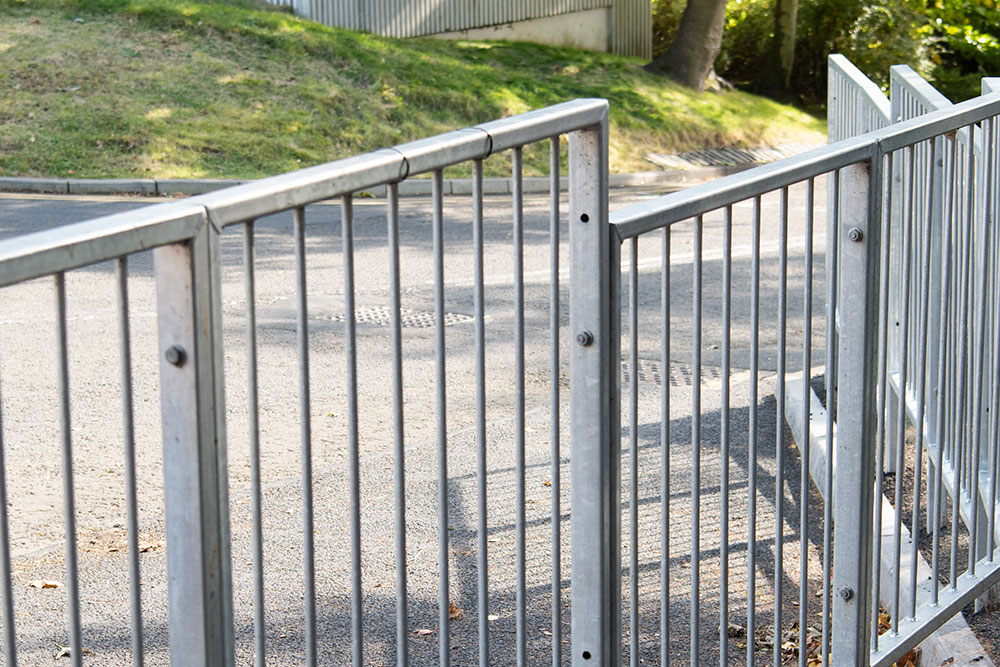
Flat top fencing is a simple, no frills design where the top of the fence is not ornate but is flat. It is available in galvanised and powder coated finishes.
Furthermore, it is very durable, safe and robust. Thus, it supplies a school with a minimalist look whilst effectively defining the school boundary.
Flat top fencing is accessible in numerous colours and heights to satisfy your needs.
Mesh panel fencing
Mesh panel fencing is made from strong stainless steel or galvanised steel. It is comprised of wire strands that have been welded together to make a robust mesh. Black and green are the most popular colours but it is also available in other colours.
The shapes and forms that can be achieved in mesh panels allows it to be visually appealing and provides a clear line of sight through the fence.
It is used in schools as it is very cost effective, especially when many designs incorporate climb resistant features.